

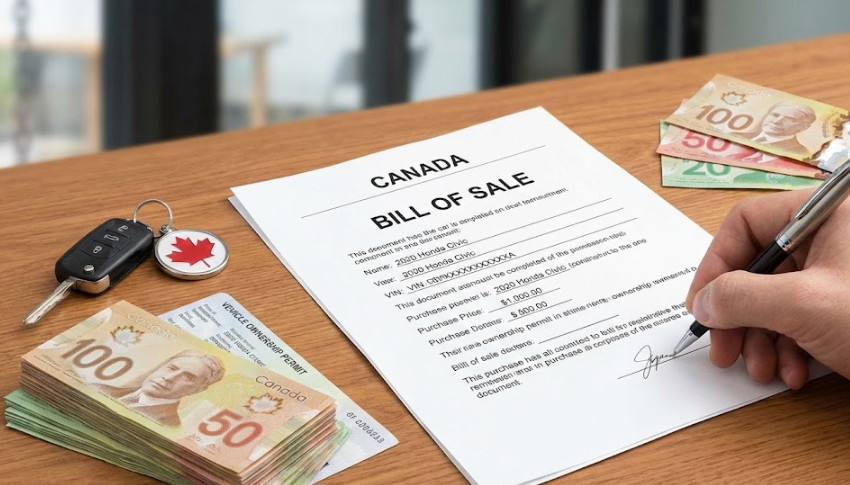
Bill of Sale Canada: Free Template + How to Write One
Quick Answer
A bill of sale is a legal document that records the transfer of ownership of an item from a seller to a buyer. In Canada, a bill of sale is commonly required for private sales of vehicles, boats, trailers, equipment, and other valuable property. A valid bill of sale must include the names and addresses of both parties, a description of the item, the purchase price, and signatures from both the buyer and seller. Most provinces do not require a specific format — it can be handwritten, typed, or use a template. Download our free bill of sale template or book a free consultation to get started.
Every year, millions of Canadians buy and sell used cars, boats, ATVs, equipment, and other personal property through private transactions. Yet many of these deals happen with nothing more than a handshake and a cash payment — leaving both parties vulnerable to disputes, fraud, and legal complications. A bill of sale solves this problem. It creates a clear, written record of the transaction that proves ownership was transferred, documents the price paid, and protects both the buyer and seller if problems arise later.
This guide covers everything you need to know about writing a bill of sale in Canada — including what to include, provincial requirements for vehicle sales, free templates for different types of transactions, and common mistakes to avoid. Whether you are selling a car in Ontario, a snowmobile in Alberta, or transferring business equipment, the same core principles apply. For related documents, see our guides to service agreements and commercial lease agreements.
What Is a Bill of Sale?
A bill of sale is a written document that records the details of a transaction in which one party (the seller) transfers ownership of an item to another party (the buyer). Think of it as a detailed receipt that goes beyond simply recording the price — it identifies the item, describes its condition, states the terms of the sale, and provides legal proof that ownership has changed hands.
In Canada, a bill of sale serves several critical purposes: it provides legal proof of ownership transfer, it documents the purchase price for tax purposes (provincial sales tax on private vehicle sales is based on the bill of sale or fair market value — whichever is higher), it protects the seller from future liability once the item is sold, and it protects the buyer by documenting the agreed condition and any warranties.
A bill of sale is a legally binding document when signed by both parties. Our service page has more detail on whether a bill of sale is legally binding and how to make yours enforceable.
When Do You Need a Bill of Sale in Canada?
🚗
Vehicle Sales
Required in most provinces for private car, truck, motorcycle, ATV, and snowmobile sales. Needed to register the vehicle and pay sales tax.
⛵
Boats & Watercraft
Required to transfer ownership of boats, personal watercraft, and any vessel registered with Transport Canada. Includes hull ID number.
🏠
Real Property
Sometimes used for land and home sales, though real estate typically requires a formal purchase agreement and transfer documents.
🏢
Business Assets
Used when selling equipment, inventory, furniture, or other tangible business assets. Often part of a larger asset purchase agreement.
🎸
High-Value Personal Items
Recommended for electronics, musical instruments, art, livestock, and any private sale over $500. Not legally required, but strongly advised.
🎁
Gifts & $0 Transfers
Even when no money changes hands, a bill of sale documents the transfer. Important for family vehicle gifts where tax exemptions may apply.
What to Include in a Bill of Sale
While Canadian provinces do not mandate a specific format for a bill of sale, the following elements should always be included to make the document valid, enforceable, and useful for registration purposes:
Provincial Vehicle Bill of Sale Requirements
Each province handles vehicle bill of sale requirements slightly differently. Here is a quick reference for private vehicle sales across Canada’s major provinces:
💡 Tax Tip: In Ontario and several other provinces, you pay sales tax on the higher of the purchase price or the fair market value (Red Book value). Listing a lower price on the bill of sale to reduce tax is not only ineffective (the government uses the Red Book) — it can trigger audits and penalties. Always state the true purchase price.
How to Write a Bill of Sale: Step-by-Step
Identify Both Parties
Write the full legal names and complete addresses of both the seller and the buyer. Check government-issued ID to confirm correct spelling. If either party is a business, include the legal business name and business number.
Describe the Item in Detail
For vehicles: year, make, model, body style, colour, VIN (Vehicle Identification Number), and odometer reading. For other items: brand, model, serial number, condition, and any distinguishing features. Be as specific as possible — vague descriptions invite disputes.
State the Purchase Price and Payment Terms
Write the price in both words and numerals (e.g., “Five Thousand Dollars ($5,000.00)”). Specify how payment is made: cash, certified cheque, bank draft, e-transfer, or installments. If payment is in installments, consider also using a promissory note.
Include an “As-Is” or Warranty Clause
If the item is sold without guarantees, include a clear “as-is” statement. If the seller is offering warranties (e.g., engine warranty for 30 days), describe them in detail. Note that provincial consumer protection laws may imply certain conditions even on “as-is” sales.
Add a Lien Declaration
The seller should declare that the item is free from all liens, encumbrances, and legal claims. For vehicles, the buyer should independently verify this through a lien search (available through provincial registries like PPSA in Ontario).
Sign, Date, and Keep Copies
Both the buyer and seller must sign and date the bill of sale. Each party keeps a copy. The buyer needs the original for vehicle registration. Consider having a witness sign as well for added protection.
Free Bill of Sale Template (General Purpose)
The following bill of sale template works for vehicles, equipment, and general personal property across Canada. For a downloadable version, visit our bill of sale template page.
BILL OF SALE
Date: [DATE]
SELLER: [Full Legal Name], of [Full Address, City, Province, Postal Code]
BUYER: [Full Legal Name], of [Full Address, City, Province, Postal Code]
ITEM DESCRIPTION:
Year: _________ Make: _________ Model: _________
Colour: _________ VIN: _________
Odometer Reading: _________ km
[For non-vehicle items: describe item, brand, model, serial number, condition]
PURCHASE PRICE: [Amount in Words] Dollars ($[AMOUNT]) paid by [cash / certified cheque / bank draft / e-transfer].
CONDITION: The item is sold “AS-IS” without any warranties or guarantees of any kind. The Buyer acknowledges having inspected the item and accepts it in its present condition. [OR: The Seller warrants that ________________ for a period of ________ days from the date of sale.]
OWNERSHIP DECLARATION: The Seller declares that they are the lawful owner of the above-described item and that it is free and clear of all liens, encumbrances, and legal claims.
_________________________ _________________________
Seller Signature Buyer Signature
_________________________ _________________________
Print Name Print Name
Need a Customized Bill of Sale?
A lawyer can create a bill of sale tailored to your transaction — whether it is a vehicle, boat, business equipment, or private property sale. Free 10-minute consultation.
Bill of Sale for Business Assets and Equipment
When a bill of sale is used for business assets — equipment, machinery, inventory, furniture, or vehicles owned by a business — additional considerations apply. The bill of sale should list each asset individually (or reference an attached asset schedule), specify whether GST/HST applies, and address any existing liens registered under the Personal Property Security Act (PPSA).
For larger transactions involving the sale of an entire business, a standalone bill of sale is usually part of a broader asset purchase agreement that covers additional elements such as non-compete obligations, employee transfers, and intellectual property assignments. If you are purchasing a business, you should also consider a non-compete agreement with the seller and ensure proper share purchase or asset purchase documentation. Protecting confidential business information during the transaction with a non-disclosure agreement is also recommended, as is having a solid contract governing the overall deal.
Understanding “As-Is” Sales in a Bill of Sale
When a bill of sale states the item is sold “as-is,” it means the seller makes no promises about the condition, quality, or fitness of the item. The buyer accepts the item in its current state, and the seller is not liable for any defects discovered after the sale. This is extremely common in private vehicle sales across Canada.
⚠️ Consumer Protection Note: Even in “as-is” private sales, provincial Sale of Goods Acts may imply certain conditions that protect the buyer — such as the seller having the right to sell the goods and the goods matching their description. In Ontario, the Sale of Goods Act implies a condition that the seller has the right to sell and that the goods are free from undisclosed liens. A seller who misrepresents the item’s condition or conceals known defects may be liable even in an “as-is” sale. For additional protection, buyers may request the seller sign a release agreement as part of the transaction.
Common Mistakes When Writing a Bill of Sale
Not including the VIN. Without the Vehicle Identification Number, the bill of sale cannot be used to register the vehicle. Always verify the VIN on the vehicle matches the VIN on the ownership documents.
Understating the purchase price. Some buyers and sellers agree to list a lower price to reduce sales tax. This is illegal and can result in fines, audits, and issues with vehicle registration. Provinces use fair market value databases anyway.
Missing signatures. A bill of sale must be signed by both parties to be valid. An unsigned bill of sale provides no proof of the transaction and cannot be used for vehicle registration.
Not checking for liens. If the vehicle has an outstanding loan, the lender has a lien on it. The buyer could lose the vehicle if the seller defaults. Always conduct a PPSA lien search before completing the purchase.
Using only a verbal agreement. Even for small transactions, a written bill of sale protects both parties. Without a document, it becomes your word against theirs if a dispute arises. This is especially important when dealing with a breach of contract claim.
Frequently Asked Questions About Bills of Sale in Canada
Is a bill of sale legally binding in Canada?
Yes. A bill of sale signed by both parties is a legally binding document in Canada. It serves as proof of the transfer of ownership and the agreed terms of the sale. If either party breaches the terms, the other can use the bill of sale as evidence in court.
Can a bill of sale be handwritten?
Yes. In all Canadian provinces, a handwritten bill of sale is valid as long as it includes all the required information and is signed by both parties. It can also be typed, printed from a template, or created digitally. Ontario will accept handwritten originals at ServiceOntario centres.
Do I need a bill of sale for a car in Ontario?
Yes. A bill of sale is required for all private vehicle sales in Ontario. It is included as part of the Used Vehicle Information Package (UVIP), which the seller is legally required to provide. The buyer needs the bill of sale to register the vehicle at ServiceOntario within 6 days of purchase.
Does a bill of sale need to be notarized?
No. A bill of sale does not need to be notarized to be valid in Canada. However, some provinces (like Newfoundland) may require a sworn affidavit in certain situations. Having the document witnessed by an independent third party can add an extra layer of protection.
How do I make a bill of sale for a car in Canada?
Include the date, full names and addresses of both buyer and seller, the vehicle’s year, make, model, colour, VIN, and odometer reading, the purchase price, an “as-is” or warranty statement, a lien declaration, and signatures from both parties. You can use the UVIP form (Ontario), a provincial standard form (Alberta), or create your own document.
What is a bill of sale for a car?
A bill of sale for a car is a legal document that records the private sale of a vehicle from the seller to the buyer. It includes the vehicle details (year, make, model, VIN), the purchase price, the condition of the vehicle, and the names and signatures of both parties. It is the primary document used to transfer vehicle ownership and register the vehicle in the buyer’s name.
Where can I get a bill of sale form in Canada?
In Alberta, a standard bill of sale form is available from the provincial registry. In Ontario, the UVIP includes a bill of sale section. For other provinces and general-purpose use, you can download a free template from our template library. You can also write your own as long as it contains all the required elements.
Can I sell a car without a bill of sale?
In most provinces, the buyer needs a bill of sale to register the vehicle in their name. Without it, the transfer cannot be completed at the provincial registry. Even where not strictly required (like New Brunswick), a bill of sale protects both parties and is strongly recommended for any private sale.
Do I need a bill of sale for a boat or ATV in Canada?
Yes. For boats registered with Transport Canada, a bill of sale with the hull identification number (HIN) is required to transfer ownership. For ATVs and snowmobiles, most provinces require a bill of sale for registration — similar to a vehicle sale. Always include the serial number, make, model, and year of the watercraft or recreational vehicle.
What is the difference between a bill of sale and a receipt?
A receipt simply confirms that payment was made. A bill of sale goes further — it documents the entire transaction including party identification, item description, condition, warranties, lien declarations, and ownership transfer. A bill of sale is a legally enforceable document; a receipt is merely proof of payment.
Protect Your Next Sale or Purchase
Whether you are selling a car, buying equipment, or closing a business asset deal, a properly drafted bill of sale protects everyone involved. Get a lawyer-reviewed document — free consultation.